As artificial intelligence becomes embedded in clinical workflows, questions of trust have become practical rather than theoretical. Health systems are no longer evaluating whether AI can be applied to clinical problems. They are evaluating whether it can be relied upon in environments where accountability, safety, and scale all matter.
In healthcare, trust does not come from capability alone. It develops through repeated exposure to how systems behave in daily use—whether outputs are consistent, whether clinical context is preserved, and whether review effort remains manageable as volume increases.
This document examines trust in clinical AI as an operational outcome, not a declared attribute. It focuses on how trust is established, how it degrades, and why many AI systems that perform well in isolation struggle to achieve sustained adoption in real clinical settings.
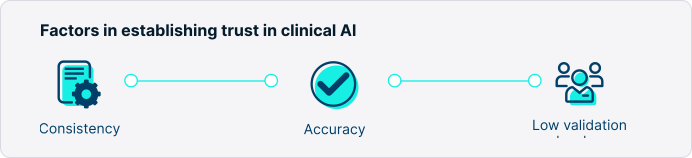
Trust is not something that can be added to an AI system through configuration, documentation, or explanation. In clinical settings, trust is inferred from experience.
Care teams—including care navigators, care coordinators, and clinicians—assess trust by observing how a system behaves over time. They notice whether outputs are consistent, whether errors are predictable, and whether the system reduces or increases the work required to act safely on its results.
AI systems that require frequent clarification or correction may still be used, but they are used cautiously. Systems that behave predictably and preserve clinical context require less active oversight and are more likely to be incorporated into routine workflows.

Clinical AI operates in environments where responsibility for decisions remains with human professionals. Even when AI informs a decision, clinicians and health systems remain accountable for outcomes.
As a result, AI outputs are evaluated not only for correctness, but for reliability. Variability, ambiguity, or unexplained behavior increases the need for verification and limits how comfortably AI can be relied upon in practice.
In this context, trust is closely tied to operational impact. AI systems that technically function but introduce additional verification steps, manual reconstruction of context, or repeated second-guessing fail to meet the threshold required for sustained use.
Loss of trust in clinical AI typically appears as friction in daily workflows rather than outright rejection. When trust is weak, care teams compensate by rechecking outputs, returning to source documents, and manually reconstructing context before acting. These steps may be necessary safeguards, but they add time and effort to already constrained workflows.
Over time, this review effort becomes the primary way the system is experienced. AI that requires constant verification may still be consulted, but it is not relied upon. The system remains visible and actively managed rather than receding into routine use.
This accumulated review effort is commonly referred to as Validation Burden—the human effort required to make AI outputs safe to use in clinical decision-making. Validation Burden does not reflect a lack of oversight. Human review is essential in healthcare. Instead, it reflects how much review is required.
When AI outputs are incomplete, inconsistent, or difficult to verify, validation effort expands. When outputs are predictable, traceable, and contextually sound, validation effort becomes more focused and efficient.

Trust in clinical AI develops through repeated exposure to system behavior under real operating conditions.
Early performance matters, but consistency matters more. Care teams pay attention to whether outputs remain reliable across different cases, users, and time periods. Predictable behavior reduces the need for constant verification.
Unexpected variability—even when infrequent—has a disproportionate impact. Each surprise prompts additional scrutiny, which slows adoption and increases review effort.
Over time, care teams develop an implicit assessment of whether a system can be relied upon. AI systems that earn trust require less active attention during routine use. Systems that do not remain subject to ongoing verification
Systems that behave predictably reduce the need for constant attention. Outputs follow expected patterns. Errors, when they occur, are understandable and traceable. Care teams learn how the system behaves and can anticipate its limitations.
By contrast, systems that behave inconsistently require ongoing monitoring. Variability in outputs, unexplained differences across similar cases, or changes in behavior over time increase the need for verification. Even when overall performance appears acceptable, uncertainty limits reliance.
Trust emerges when system behavior aligns with clinical expectations. Determinism, consistency, and verifiability allow AI to support clinical work without becoming an additional object of scrutiny.

Some AI approaches prioritize flexibility, breadth, or adaptability. Others prioritize consistency, traceability, and predictable behavior. These choices affect how outputs are reviewed, verified, and acted upon in practice.
Architectures that introduce variability by design may perform well in aggregate but require greater human effort to validate individual outputs. Architectures that emphasize deterministic behavior and explicit relationships tend to produce outputs that are easier to review and integrate into clinical workflows.
When architecture supports predictable behavior and clear provenance, human oversight remains focused and efficient. When architecture produces opaque or variable outputs, oversight expands and trust becomes harder to sustain.

Programs scale when AI outputs can be reviewed efficiently and acted upon consistently. When trust is established, review effort remains proportional as volume increases. AI supports workflows rather than reshaping them around validation.
When trust is absent, scale introduces friction. As volume grows, review effort grows with it. Validation Burden expands, and systems that appeared viable at small scale become difficult to sustain.


.png)